
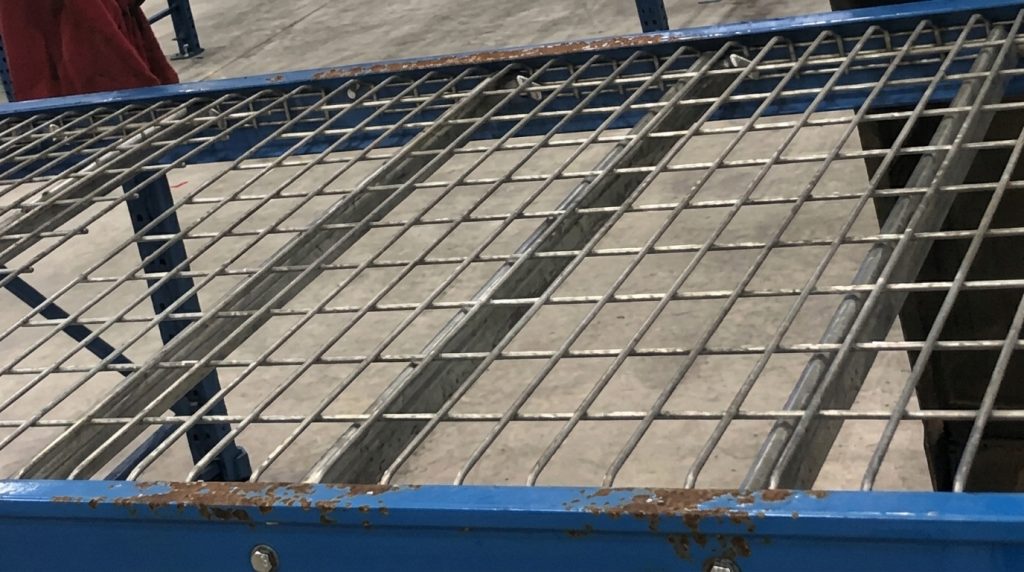
Old wire decking should be considered for replacement when it has significant damage, corrosion, deformation, damaged support channels, impact damage, a poor fit, or no longer meets the current load requirements of the rack. Age alone does not determine whether wire decking needs replacement.
Wire decking can sit in a warehouse for years without attracting much attention. If pallets are moving normally and nothing looks obviously wrong, it’s easy to assume the decking is still fine. But deciding whether older wire decking needs replacement isn’t really a question of age alone.
A deck can be several years old and still be appropriate for its application. Another may need replacement after an impact, visible damage or a change in what the rack is being used to store.
A useful inspection starts with the condition of the decking and then checks whether its working-load rating, fit and configuration still match the current storage requirements.
Start With a Visual Inspection
Start with a visual inspection of the decking. Check for:
- Bent or distorted wires
- Broken or damaged welds
- Damaged or displaced support channels
- Visible corrosion
- Forklift or pallet impact damage
- Decking that no longer sits properly on the rack beams
Not every mark means the deck needs to be replaced. However, bent wires, damaged welds or support channels, significant corrosion, impact damage or a deck that no longer sits correctly on the beams should be evaluated before continued use.
If the damage appears significant or you’re unsure whether the decking remains suitable, have it evaluated before continuing to use it for storage.
Check the Working-Load Rating
A deck can look perfectly fine and still be unsuitable if the load requirements have changed. Check the working-load rating for the specific decking configuration and compare it with what is being stored today.
Our wire mesh decking working-load ratings are established through ANSI MH26.2 testing for uniformly loaded decking, with testing considering both deflection and structural collapse. The decking rating is not the capacity of the entire rack, so the rack manufacturer’s load rating must also be followed.
This is particularly important when a warehouse starts storing heavier pallets, changes pallet dimensions or changes how products are distributed across the rack.
Ask What Has Changed
Sometimes the decking hasn’t changed, but the warehouse has.
- Have you started storing heavier pallets?
- Are the pallet dimensions different?
- Has the rack been reconfigured?
- Is the decking being used for a different application than it was originally intended for?
Those changes can be just as important as physical damage.
When deciding whether replacement is necessary, check whether the current application still matches the requirements the decking was selected for. If it doesn’t, wire decking replacement or further assessment may be appropriate even when the deck looks undamaged.
Look Closely at Corrosion and Wear
Corrosion is an important reason to inspect wire decking, but the inspection should also cover the wires, welds, and support channels. Look at the wires, welds, and support channels for visible deterioration or damage. Also consider the warehouse environment and whether repeated handling has caused wear over time.
GALVA-DECK® uses galvanized wire mesh designed to provide corrosion protection and abrasion resistance. However, galvanized decking should still be inspected for physical damage, impact, and wear during service.
Age is a reason to inspect the decking, not an automatic reason to replace it. Its condition and current application provide more useful information about whether replacement is necessary.
Check That the Deck Still Fits
The decking should sit correctly on the supporting rack beams without being displaced or improperly positioned. If decking has been moved, replaced, or used with a changed rack configuration, make sure it still fits the supporting beams properly. A poor fit can be overlooked when the warehouse is busy, particularly when the decking has been in place for a long time.
At J&L Wire Cloth, we manufacture different wire decking configurations for different rack applications, so the right configuration depends on the rack and how it’s being used. If the existing deck no longer fits the rack or matches the application, that’s a reason to investigate rather than simply work around the problem.
Establish a Regular Inspection Schedule
Don’t wait for obvious damage before checking the decking. A regular visual inspection can help identify problems earlier. The inspection schedule should reflect the warehouse environment, forklift traffic, storage conditions, and applicable safety requirements. There is no single interval that fits every facility.
It’s also worth checking the decking after a known forklift or pallet impact and whenever there is a significant change to stored loads or the rack configuration.
The goal is simple: make the condition of the decking part of routine rack checks instead of something that only gets attention after a problem appears.
When Should Wire Decking Be Replaced?
There isn’t a universal expiration date for wire decking. Replacement should be considered when you find significant damage, corrosion or deformation, when the decking no longer fits correctly, or when its working-load capacity no longer matches the current storage requirements.
If a deck is old but remains in good condition and is still suitable for the rack and its current application, age alone doesn’t tell you that it needs to be replaced.
At J&L Wire, we offer wire mesh decking in different configurations for different rack setups and applications. If you’re reviewing older decking, start with its condition and the demands being placed on it today.
Inspect the deck, verify the working-load requirements, check the fit and account for changes in the warehouse. Those factors provide a better basis for deciding whether to keep, evaluate or replace older wire decking than the installation date alone.
FAQs
When should wire decking be replaced?
Consider replacement or further evaluation when decking has significant bends, damaged welds or support channels, corrosion, impact damage, poor fit or no longer meets the current load requirements.
Does wire decking need to be replaced after a certain number of years?
No universal age determines replacement. The deck’s condition, working-load requirements, fit and current application are more useful factors to review.
Should I check the load rating on old wire decking?
Yes. Verify the working-load rating of the specific decking configuration and compare it with the loads currently being stored. The rack manufacturer’s capacity should also be considered.
What should I look for during a wire decking inspection?
Look for bent wires, damaged welds or support channels, corrosion, impact damage, displacement and signs that the deck no longer fits correctly.
How often should wire decking be inspected?
There isn’t one interval that applies to every warehouse. Establish a schedule based on the facility’s operation, forklift traffic, storage conditions and applicable safety requirements. Inspect the decking after impacts or significant changes to the rack or stored loads.